
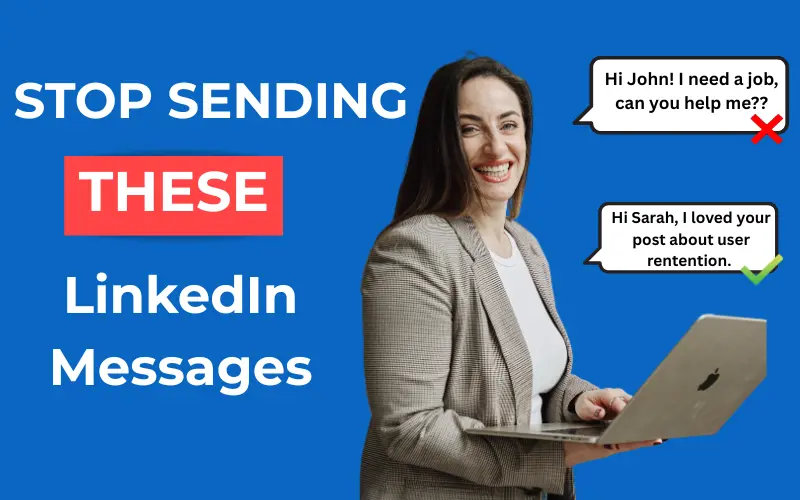
If you’ve ever sent a LinkedIn message and heard nothing back, you’re not alone. Most people are unknowingly sending messages that guarantee they’ll be ignored.
In this post (and video), I’ll show you why most LinkedIn messages fail, and the exact templates my clients use to start real conversations, even with senior leaders at companies that aren’t hiring.
The Psychology of LinkedIn Messages That Work
Before you copy another generic message, it’s important to understand why most outreach fails.
Here’s what 99% of people send:
“Hi John, I saw you work at ABC Company. I’m looking for a job and wondered if you could help. I’ve attached my CV. Thanks.”
And here’s why that doesn’t work:
- It’s all about you. You’re asking for help before building any trust.
- It shows no research, it could be sent to anyone.
- It puts the other person in an uncomfortable position. You’re asking for a professional favour from someone who doesn’t know you.
From the recipient’s point of view, this comes across as rushed and unprofessional. So instead, your message needs to create curiosity, not pressure.
The Three Principles of Messages That Get Replies
- Reciprocity — give before you ask.
Share an insight, offer a perspective, or comment meaningfully on their work. Intelligent generosity signals professionalism. - Curiosity over neediness — approach with curiosity, not desperation.
You’re doing research, learning about the industry, and building genuine connections — not asking for a job. - Specificity — generic “opportunity” messages sound lazy.
Be precise about their company, role, or industry. It shows drive and focus.
When you apply these three principles, your messages feel confident, authentic, and engaging, not needy or transactional.
Template 1: Connecting With Peers
Here’s an example that actually works:
“Hi Sarah, I see we both work in product management.
I’ve been following the challenges around user retention in SaaS, and I noticed you’ve posted some really insightful thoughts about this.
I’m always keen to learn from people in my discipline and would love to connect.”
Why it works:
- It shows research and relevance.
- It positions you as a peer, not a job seeker.
- It acknowledges their expertise, people love being noticed for their work.
When they accept your request, follow up within 24 hours. Don’t let the connection go cold.
Template 2: Connecting With Senior Leaders
When reaching out to more senior professionals, you need to balance respect with confidence.
“Hi Michael, I work closely with product directors in my current role and have been really impressed by what I’ve seen from your team at XYZ Company.
Your approach to user experience really stands out in the market.
I’d love to connect and learn from your experience as I continue growing my network in this space.”
Why it works:
- You acknowledge their seniority without sounding deferential.
- You reference a specific achievement, showing deep research.
- You position networking as professional development, not job hunting.
Again, once they accept your request, slow down. Send a thoughtful follow-up message that relates to their work, not a copied script.
Template 3: The Company Research Approach
This one’s my favourite because it shows genuine interest and preparation.
“Hi Jennifer, I’ve been following ABC Company’s expansion into the European market, really impressive growth!
I saw your recent post about the challenges of scaling customer success internationally, and having worked in CS for five years (including with international clients), I found your insights really valuable.
It would be great to connect.”
Why it works:
- It proves you’ve done current research, not surface-level reading.
- It highlights your relevant experience naturally.
- It shows professional curiosity instead of self-promotion.
When they respond, don’t immediately ask for a call. Build rapport with a few messages first, then, when you do suggest a chat, frame it as learning, not job-seeking.
How to Ask for a Call (Without Killing the Relationship)
Once you’ve exchanged a few messages and the rapport feels natural, you can say something like:
“I’ve really enjoyed our conversation and learning more about [industry/company].
Would you be open to a short 20-minute chat to exchange insights offline?”
During the call:
- Spend 80% of the time asking about them, their experience, and challenges.
- Use the last 20% to share your perspective or relevant experience.
- End with a light, authentic close:
“Everything you’ve shared only reinforces why this is exactly the kind of organization I’d love to contribute to one day.”
You’re not asking for a job, you’re building genuine professional relationships.
Three Mistakes That Ruin Great Outreach
- Being impatient — Don’t chase replies within 48 hours. People are busy. Move on gracefully.
- Being generic — If you can copy your message to 50 people, it’s too vague. Take the time to personalize.
- Being needy — “Please help me” energy repels people. Curiosity attracts them.
Great networking feels like professional growth, not job hunting.
Your Next Step
Pick one person from your target company list and draft a personalized message using one of the templates above.
But don’t send it yet.
First, engage with their content for a week so your name feels familiar when the message arrives.
All the templates (plus my network tracker spreadsheet) are linked below to help you stay organized.