
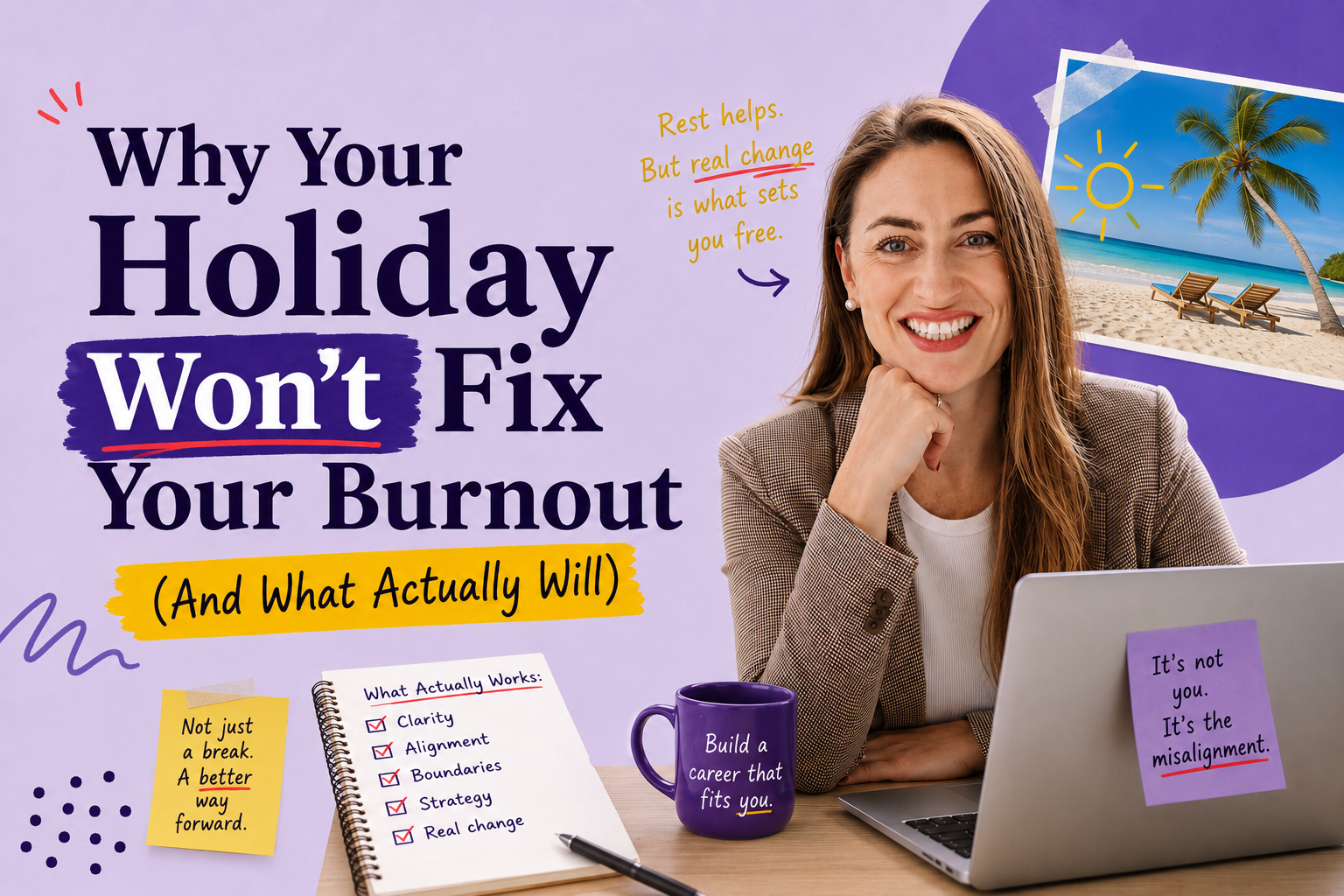
Every summer, the same thing happens.
You count down the days until your break. You fantasise about lying on a beach with no emails, no meetings, no one needing anything from you and when it finally arrives, it’s glorious.
Pure damn bliss!
But then you come back and somewhere around day three at your desk, it all creeps back in. The heaviness, the Sunday dread, the exhaustion that has nothing to do with how much sleep you got.
And you’re so pissed off, because you were certain that this time, after the summer break, it’d be different and you’d be feeling better.
You start to ask yourself: what is wrong with me? I just had two weeks off. Why do I feel like this already?
Nothing is wrong with you, but something might be wrong with the assumption that a holiday was ever going to fix what you’re feeling….
The two types of burnout people don’t distinguish
When people say “burnout,” they usually mean one thing. However in my experience, there are actually two very different versions, and mixing them up is why so many people stay stuck.
Type 1: Overwork burnout
This is the one most people recognise. You love your job, or at least you like it well enough, but there’s simply too much of it. Too many hours, too many deadlines, too many people needing your time.
The work itself isn’t the problem. The volume is.
A holiday genuinely helps with this. So does setting boundaries, having honest conversations about workload, and learning to say no without feeling guilty.
If this is you, rest works. It recharges you because the battery itself is fine, it was just drained.
Type 2: Misalignment burnout
This one is sneakier and it’s the one I see far more often with my clients.
You’re not necessarily overworked. The hours might even be reasonable, but the work itself drains you. Not because it’s hard, but because it doesn’t fit.
You might be using skills you’ve outgrown or you’re in an environment that clashes with your values. You might have simply changed as a person, and the job hasn’t changed with you.
Misalignment burnout doesn’t respond to rest. You come back from holiday feeling refreshed for a few days, and then the same feeling returns because nothing structural has changed. You’re still in the wrong room.
How to tell which one you’re in
There’s a simple test I use with my clients.
Imagine your current job, same role, same company, same team, but a decreased workload and a four day week instead of five. Would you genuinely feel different?
If the answer is yes, it’s probably overwork. The job fits, you just need less of it.
If the answer is no, or if you hesitate, it’s likely misalignment. An extra day off won’t fix a role that doesn’t fit who you are.
Another test: think about the last time you felt genuinely energised at work. Not just “fine” or “okay,” but actually engaged. How long ago was that?
If it’s been months, or if you can’t remember, that’s a signal worth paying attention to.
What actually fixes misalignment burnout
Step one is acknowledging it. Most people spend years calling it tiredness, or stress, or “just a phase.” The longer you avoid naming it, the longer you stay in it.
Step two is understanding what’s actually misaligned. Is it the work itself? The environment? The culture? The pace? The people?
In my programme, we start here. Not with CVs or job boards, but with who you actually are, what drives you, and where the gap between that and your current reality sits.
Step three is building a strategy that addresses the real problem, not just the symptoms.
Sometimes that means a new job. Sometimes it means a new company. Sometimes it means a completely different direction and sometimes, it means having a very honest conversation with your current employer about what needs to change.
This summer
Enjoy your holiday, switch off, rest and do whatever recharges you.
But if you come back and that familiar heaviness returns within a few days, don’t blame yourself, and don’t start googling “best holiday destinations for January.”
Instead, ask yourself the honest question: is this an energy problem, or a fit problem?
Because the answer to that changes everything about what to do next.
If you’d like help figuring out which one it is feel free to book a exploratory call with me by clicking HERE